Connect ideas across industries
Stop asking for “faster horses.” Cross-pollinate methods from different fields to find hybrid concepts and fresh ways to solve a customer problem.
 Your Idea Forge
 · AI Powered Agents
Don't build for the past. Let AI Power Agents simulate competitor reactions so you can launch the future today.
Start with a Your Idea Forge evaluation, then extend it through focused research, creative exploration, risk analysis, and execution planning.
From a baseline to better questions
AI Power Agents are designed to extend the initial evaluation through different lenses, so founders and advisors can see alternatives, risks, and next steps in one connected process.
Stop asking for “faster horses.” Cross-pollinate methods from different fields to find hybrid concepts and fresh ways to solve a customer problem.
Before you spend a dime, sharpen the axe. Surface missing assumptions, risks, and evidence gaps, then turn them into a practical action plan.
Use current market signals to challenge demand, customer fit, and business-model assumptions before committing time or money to a build.
Turn abstract concepts into a venture-ready sequence of decisions, work, and tests, with a clear path from evaluation to action.
The agentic idea validation model
The infographic shows the proposed flow between outside research and strategic analysis, with Your Idea Forge organizing evidence and results for the next decision.
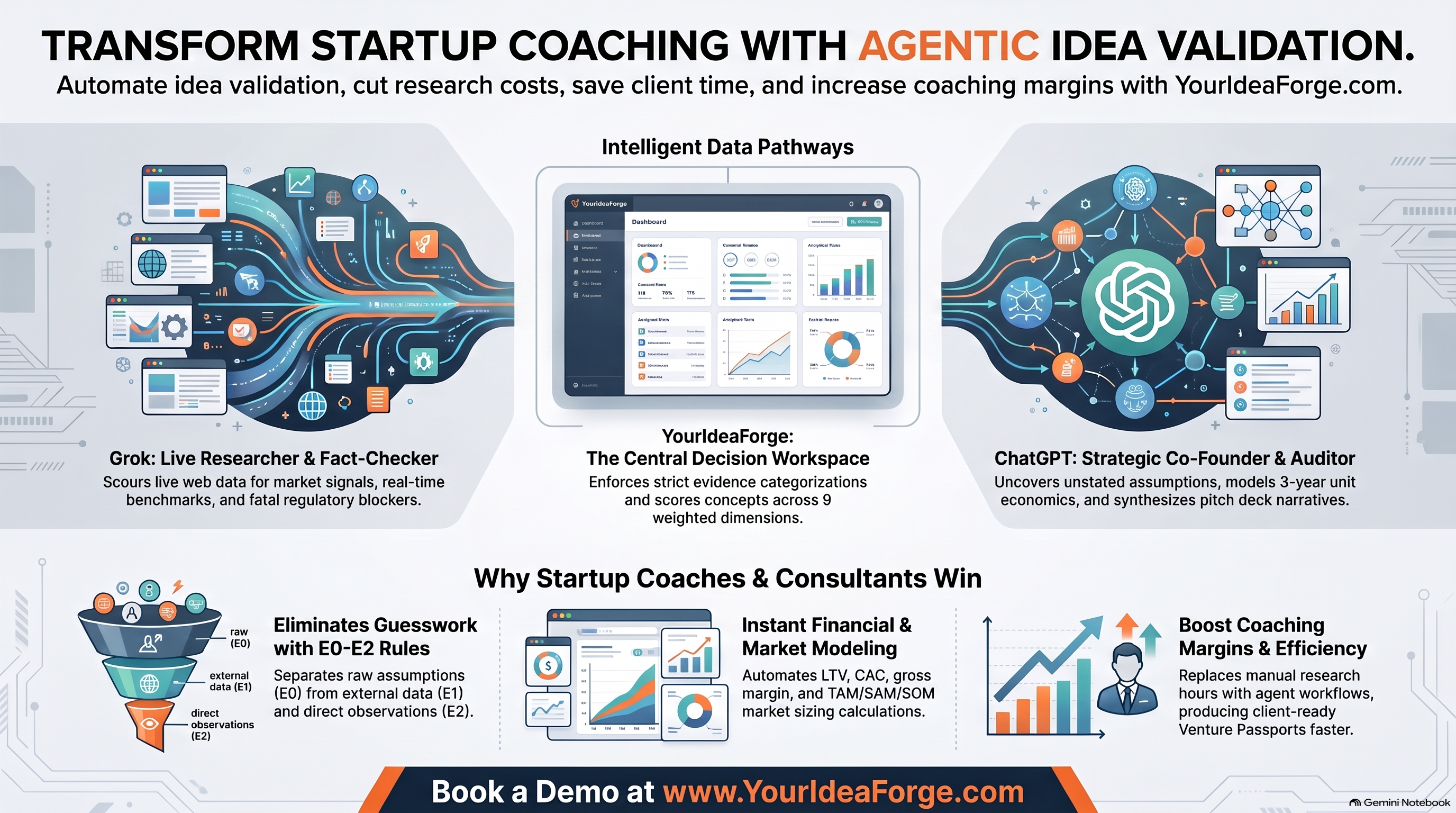
How the workflow connects
The agent workflow begins with the idea evaluation and returns a connected set of findings and actions for review.
Create the initial idea evaluation and establish a baseline.
Format the evaluation into context that specialized agents can use.
Run focused research, critique, expansion, and planning modules.
Use each module's output to inform the next analysis.
Bring the resulting roadmap and evidence into one decision workspace.
Ten focused modules
Use the modules individually or chain their outputs, for example, feeding blind-spot findings into idea expansion and action planning.
Generate variations, pivots, and alternative angles from a core concept.
Cross-reference a concept with market trends, search signals, and current events.
Combine approaches from different industries to explore novel hybrid solutions.
Model how competitors or market leaders may respond and consider possible strategic moves.
Organize the story, value proposition, and slide sequence for a clear presentation.
Draft target audience profiles and explore likely feedback before building.
Critique assumptions and identify missing elements that need attention.
Explore names, taglines, and a cohesive brand direction for a concept.
Map likely skills, time, and capital needed to execute the plan.
Translate an idea into a sequential plan with concrete next actions.
The goal
AI can expand the analysis and prepare an execution path. Founders and advisors review the evidence and decide what to pursue.